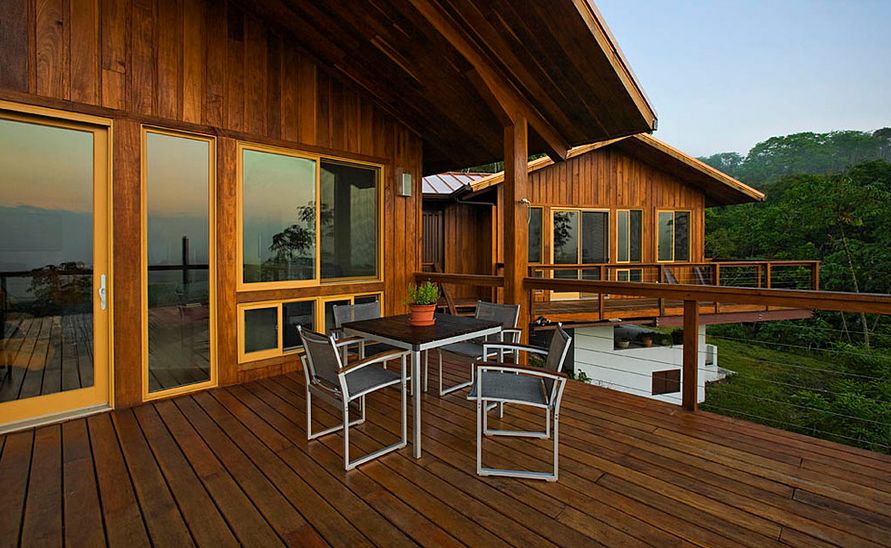
 Cable railings use horizontal or vertical cables in place of spindles, glass or other options. They have multiple uses and they are usually preferred to other systems because of their ability to offer nearly unobstructed views. Since the cables are much thinner than pickets, they are ideal for decks or terraces that can offer panoramic views.
The same characteristics mentioned above allow cable railings to look sleek and modern, making them suitable for contemporary residences and commercial spaces. In addition to that, maintenance is really easy in the case of cable railings.{found on designsnw}.
The installation of cable railings is a complex but relatively simple process. Due to the tension applied to the end posts by the cables, the frames and posts need to be strong in order to be able to withstand the force and load requirements.{found on davidmatero}.
Cable railings need very rigid frames and typically they are constructed of either stainless steel, extruded aluminum or wood. Building code requirements state that the cables must be rigid enough to prevent a 4” sphere from passing through them.
 The cables are available in galvanized carbon steel, type 304 stainless steel as well as a highly corrosion resistant types of stainless steel which is best for coastal areas.
The rigidity of the cable is influenced by a series of factors such as the tension, the spacing of the posts, the cable’s diameter and several others.
Flexibility is important in the case of these cables. The tension needs to be just right so no body parts can slip through and the posts and end fittings stay firm and in place.
The intermediate posts need to be spaced out properly. They provide mounting for the top rail and have a row of holes that support the cables as they pass through them. It’s generally recommended that the spacing between the posts be no more than 5 ft although some manufacturers require 3 ft to the center.
Cable spacing is also important for the minimization of cable deflection. Usually, the maximum spacing that’s recommended is no bigger than a 3” opening between the cables.
The cable end fittings are the elements that keep the whole system in place and tie everything together. The cables are attached to one end of the fitting while the other end is attached to the post. You can use tensioning or non-tensioning fittings depending on the system requirements and local building codes.

It’s possible to install the cables into your existing railing system and this way to reduce the cost of the installation and materials. However, you need to make sure all the requirements are fulfilled.
And speaking of cost, the price of cable railing varies based on a series of factors such as the type of material used, the supplies and tools needed and labor. Usually, it’s double the cost of typical deck rails.
You can reduce the cost through a variety of methods. For example, you can buy discount materials, install the railing yourself, combine similar jobs to get a discount, install it during a low demand period or have multiple vendors bid on the same project.
Read more on https://www.homedit.com/how-to-choose-cable-railings/

No comments:
Post a Comment